Structure
Run innovation like a system
“Innovation flourishes in a clear structure. Work in three connected phases: Inspire & Assess, Plan & Design, Execute & Evolve.”
Grow attention. Strengthen financials. Boost sports performance.
Published as The 10 Rules of Sports Innovation, read as what they are: ten rules of value creation for the people who run and back spectator sports organisations. They move the work from a departmental side project into a leadership discipline, with more than eighty templates and a Practice Time chapter that calibrates every rule to five revenue tiers, from Grassroots to Elite.
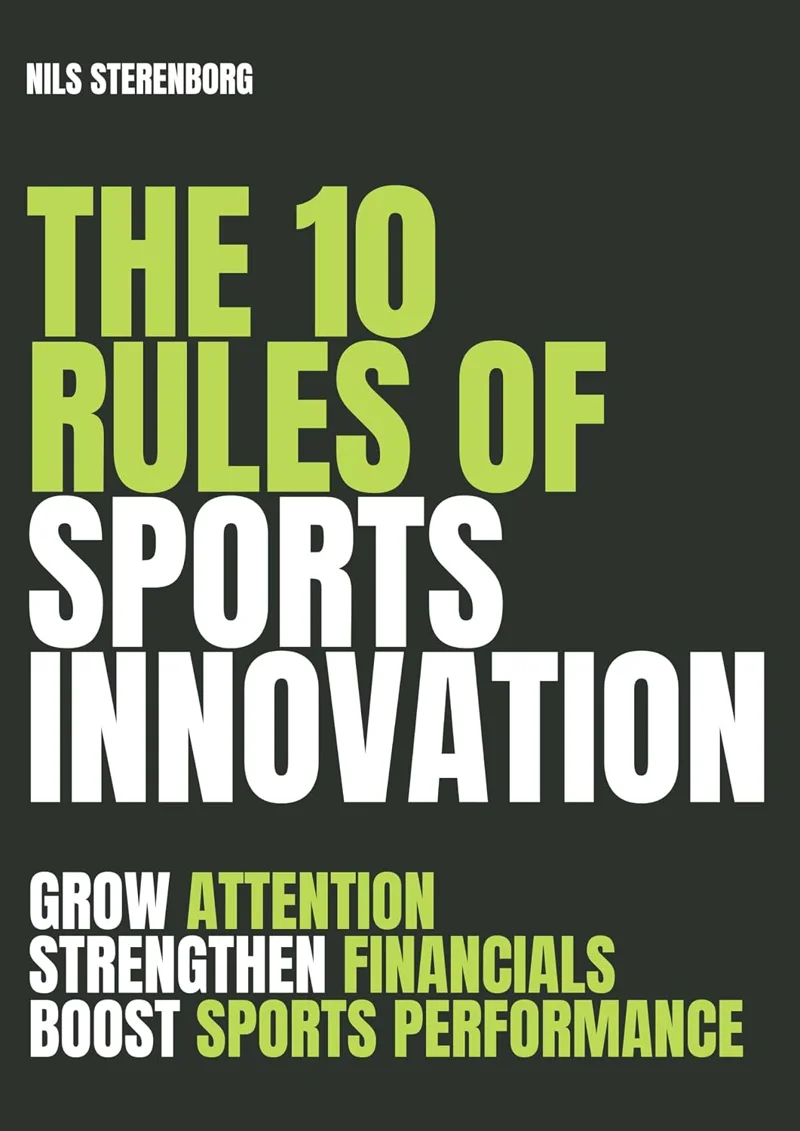
Power Play described the framework. The 10 Rules distil it into principles a leadership team can apply on Monday, return to every quarter, and use to defend a decision in front of a board.
The question changes from what we should understand to how we act, and from what is possible to what is practical. Each rule comes with its own template set, so the principle never stays abstract.
For Andy, who once asked me whether an innovation management framework could exist specifically for spectator sports. Well, here it is.
Dedication · The 10 Rules of Sports Innovation
Value creation in sport is not an accident, it is a craft. It can be measured, managed and repeated. Each rule below is quoted from the book, where innovation is the means and value is the measure.
Run innovation like a system
“Innovation flourishes in a clear structure. Work in three connected phases: Inspire & Assess, Plan & Design, Execute & Evolve.”
Start from your core
“Your mission, goals, and values are not just slogans, they are the compass. Translate them directly into innovation objectives using a ‘from-the-core outward’ approach.”
Know your ‘why’
“Define why you innovate by understanding three perspectives: Internal goals, Fan needs, and Partner expectations. Purpose anchors innovation in tangible value, for people, not just processes.”
Fix the foundations first
“Before chasing big ideas, know if you have the capability to deliver. Assess your digital readiness and close critical gaps first.”
Make the whole greater than the parts
“Think of your club as a platform. Invite fans, athletes, partners, media, and stakeholders to create solutions with you under clear rules for data and decision-making.”
Let value decide
“Measure innovation by its ability to create lifetime value with fans and stakeholders. Use transparent scoring to decide which projects earn investment.”
Engineer attention
“In sport, attention is the fuel of growth. Create initiatives that deliberately attract and hold attention through compelling stories and personalized experiences.”
Make the path visible
“Use simple scoring models, write concise project briefs, and maintain a living roadmap everyone can see. Without clarity, ideas drift. With clarity, they move.”
Build in small, loveable steps
“Don’t aim for perfection, aim for real use. Start with proof of concept, create minimum loveable products, and decide early whether to build, partner, or buy.”
Keep the flywheel turning
“Innovation is not a one-off project; it’s a rhythm that spins a flywheel. Build a culture of learn-build-measure in loops and double down on what works.”
The rules are sequential and interdependent. Apply them in order and something genuinely compound begins to happen.
Two short guides, same ten Rules.
Ten Rules for operators and investors in the sports mid-market. Each Rule comes with a check for the organisation and a due diligence question for the investor, plus the chain that shows how the Rules build on each other. Elite patterns. Mid-market reality.
Download the PDFThe ten Rules from the book in short form, with the test for each Rule and the chain that shows how they build on each other. Written for operators and investors in the sports mid-market. Elite patterns. Mid-market reality.
Download the PDFEvery rule is translated into a checklist for five revenue tiers. Each tier assumes the checks below it are in place. Tiers are not a ranking: many Tier 1 clubs are better run than some Tier 3 clubs with more resource and less discipline.
Under 3 million US dollars annual revenue
The flywheel is not spinning on its own yet. You are building the first momentum. The checks cost more in attention than in money.
3 to 10 million annual revenue
The wheel has begun to turn. Governance means learnings from one initiative feed the next without depending on one person's memory.
10 to 50 million annual revenue
The wheel spins consistently. The question shifts from getting it moving to accelerating it, by investing across all three pillars.
50 to 300 million annual revenue
The wheel has real momentum. The risk is drift: spinning in a direction that no longer serves your gravitational core.
Over 300 million annual revenue
The wheel is a global system. The risk is bureaucratic friction draining energy faster than innovation adds it.
The goal is not to reach Tier 5. The goal is to apply the rules with excellence at your tier.
The book's tiers are bands in US dollars for orientation. PowerSCOAR calibrates more finely, by tier, sport and market, when it scores your organisation.
Three KPIs define what you measure. The 10 Rules define how you decide. The Spectator Sports Innovation Flywheel turns those decisions into compounding value.
The templates are tools, not requirements. You can complete every check without them, and most of them faster and better with them. They are available from us on request.
Rethinking value creation in sports. In the Sunset Sports Festival edition, this chapter reads the rules as a value creation framework.
Why innovation is more than digital skills and technology, and why tools without a system are expensive experiments.
A systematic roadmap for innovation in spectator sports: alignment before action, in three phases.
Engineering sustainable momentum for growth across fans, revenue and sports performance.
A strategic compass for systematic transformation. Every rule with its principle and its templates.
The Gravitational Method, the Hedgehog Concept and the flywheel as lenses, then every rule as a checklist for five tiers.
Innovation is not a project, it never ends. Someone is always continuing. Be that someone.
A practical guide for operators and investors in the spectator sports mid-market.
The same ten rules, written from where the decisions are made: the operator running a club, league or event on a fraction of the elite's staff, and the investor deciding whether that organisation is building durable value or surviving a cycle. Innovation stays the means. Value stays the measure.
If you want to hear when it is out, tell us.
Club, league and event leaders between five and one hundred and fifty million euros in revenue who need a way to decide what to fix first and defend it to a board.
Owners, funds and family offices entering the segment who need to read whether an organisation creates value in a compounding way.
The patterns come from the top of the industry. The guide is written for the organisations underneath it.
The ebook is available now. Printed copies go to selected applicants from clubs, leagues, events, investors and universities.
Tell us what you are working on. Every applicant receives the findings, anonymised and with no organisation named: a summary of what organisations below the elite are actually stuck on. Applications are open until 30 November.
The 10 Rules of Sports Innovation extend Power Play, The Sport Innovation Playbook by Thomas Lutz and Nils Sterenborg, Meyer & Meyer Sport. The Gravitational Method, the Hedgehog Concept for sport and the flywheel were first introduced there.
The sport innovation playbook by Nils Sterenborg and Thomas Lutz, with chapters from ten practitioners. Meyer & Meyer Sport.
Read about the book → 09 / KnowledgeThe flywheel, the Gravitational Method, Fan Lifetime Value, and how SIAF became the 10 Rules.
Explore the models →Run the Fast Lane and see which part of your loop is braking, scored against the ceiling for your own tier, sport and market.